


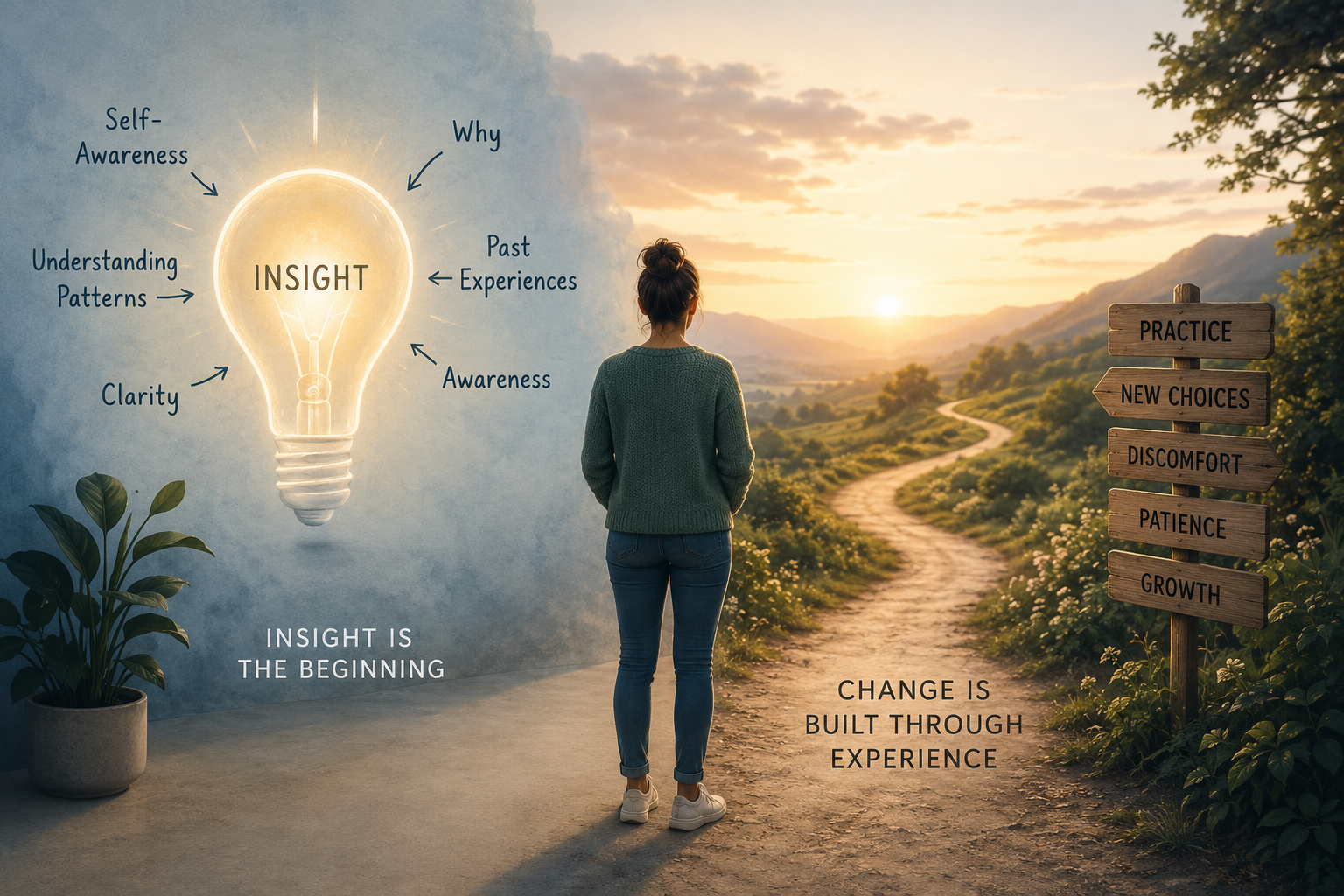
Many people come to therapy with a strong understanding of themselves.
They know where certain emotional patterns come from. They can identify the experiences that shaped them. They understand why they react a certain way in relationships, struggle with boundaries, or fall into familiar cycles of self-criticism. In some cases, they can even predict exactly when those patterns will appear.
Yet despite this awareness, meaningful change can still feel frustratingly difficult.
This often leads to an important question:
“If I understand the problem, why am I still struggling with it?”
The answer lies in the difference between awareness and action.
The Difference Between Awareness and Change
Insight is valuable.
Developing awareness of your emotions, behaviors, thoughts, and personal history creates an important foundation for growth. Therapy often helps people make connections they had never seen before. Understanding where a pattern comes from can bring relief, clarity, and self-compassion.
However, awareness alone does not automatically create new experiences.
Knowing that you tend to avoid conflict is different from speaking honestly during a difficult conversation.
Recognizing that perfectionism drives your anxiety is different from allowing yourself to make mistakes.
Understanding that childhood experiences contributed to low self-esteem is different from learning how to treat yourself with kindness today.
Insight opens the door, but change requires walking through it.
Why Old Patterns Persist
Many emotional patterns develop over years or even decades.
These behaviors often begin as adaptations that once served an important purpose. They may have helped you avoid rejection, stay safe, earn approval, or cope with difficult circumstances.
Because these patterns were repeated over time, they become familiar.
Even when they no longer serve you, familiar behaviors often feel safer than unfamiliar ones.
The brain naturally prefers predictability. During moments of stress, uncertainty, or emotional discomfort, people often return to what feels known rather than what is healthy.
This is one reason why change can feel so difficult even when motivation is strong.
Understanding a pattern does not immediately erase the emotional habits connected to it.
The Role of Discomfort in Growth
One of the biggest barriers to change is discomfort.
Growth often requires doing things that feel unfamiliar at first.
This may include:
- Setting boundaries with people who are used to unlimited access to you
- Expressing emotions honestly instead of suppressing them
- Asking for help when you usually handle everything alone
- Challenging negative self-talk
- Taking risks despite uncertainty
While these actions may be healthier, they can initially feel uncomfortable because they are different.
Many people assume discomfort means they are doing something wrong. In reality, discomfort is often a natural part of learning new emotional skills.
The goal is not to eliminate discomfort but to become more willing to move through it.
Growth Happens Through Practice
Real change typically happens through repeated experience.
Just as physical strength develops through consistent exercise, emotional growth develops through consistent practice.
This often involves:
- Repeatedly making different choices
- Building new habits
- Practicing self-awareness in real time
- Tolerating emotional discomfort
- Creating new relationship experiences
- Responding differently when old patterns appear
Over time, these new experiences begin to feel more natural.
What once felt difficult gradually becomes familiar.
This is how lasting change occurs—not through a single realization, but through repeated action.
Reflection
Take a moment to consider the following questions:
- What patterns do you understand intellectually but still struggle to change?
- What emotions arise when you imagine responding differently?
- What feels uncomfortable about doing something new?
- Are you expecting insight to do the work of practice?
These questions can help identify where growth may be waiting for action rather than additional understanding.
How Therapy Can Help
Therapy helps bridge the gap between awareness and action.
While insight remains an important part of the process, therapy also creates opportunities to practice new ways of thinking, feeling, and relating. Through reflection, emotional exploration, and real-world application, people can begin transforming understanding into meaningful change.
At MindSol Wellness Center, we believe growth involves both self-awareness and experience. Understanding yourself is an important first step, but lasting change develops through practice, patience, and support.
If you feel stuck despite having insight, therapy can help you move from understanding your patterns to creating new ones.
MindSol Wellness Center offers therapy in Sarasota, Florida.
Call (941) 256-3725 or visit www.mindsolsarasota.com to learn more.
