


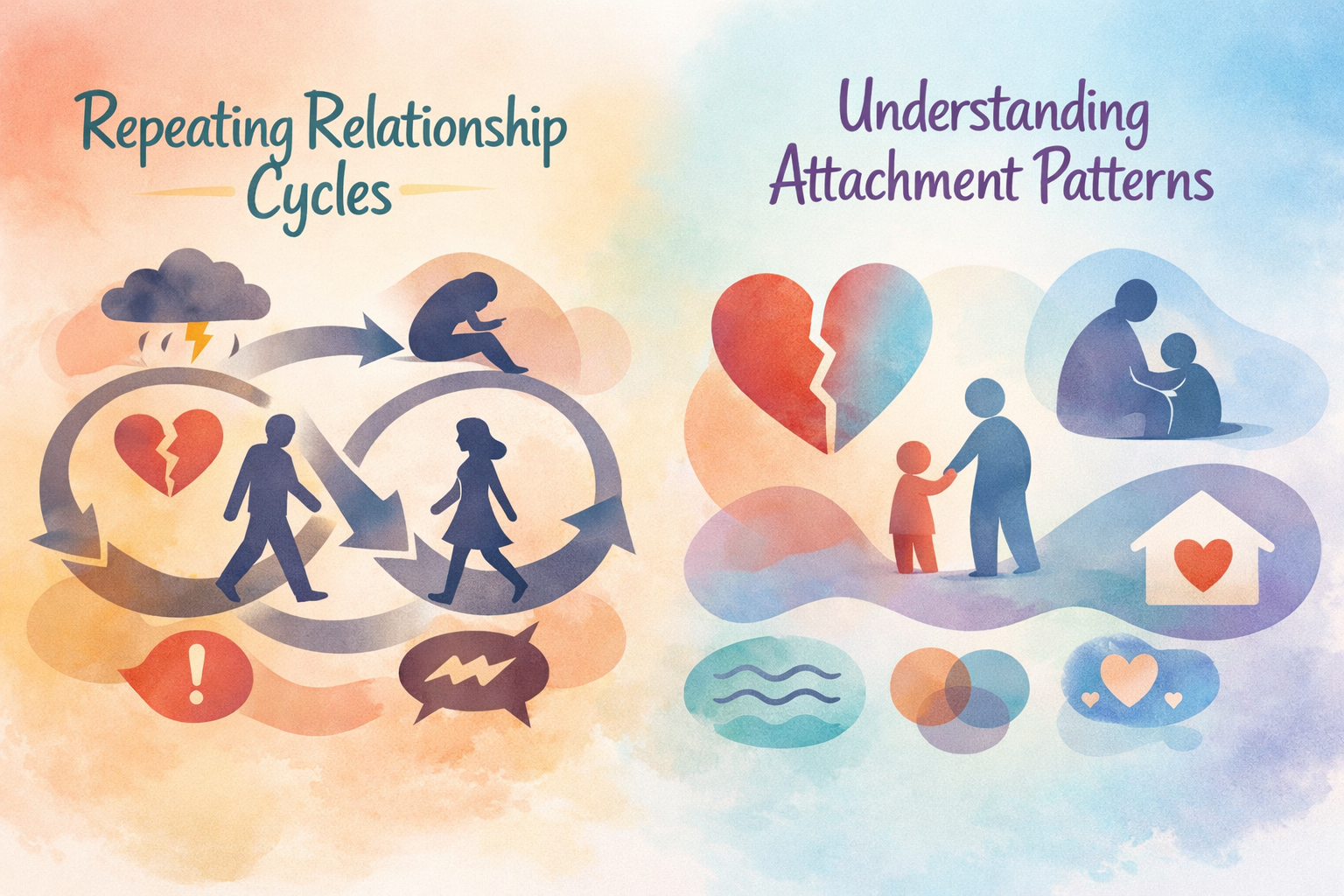
Why You Repeat the Same Relationship Patterns
When Relationships Start to Feel Familiar
Many people notice that their relationships begin to feel eerily similar over time, even when the partners themselves are very different. You might repeatedly feel unseen, emotionally over-responsible, abandoned, or caught in the same arguments no matter who you are with. Over time, this repetition can lead to confusion and frustration. You may wonder why you keep ending up in the same emotional place or question whether something is wrong with you.
These patterns are rarely coincidental. Relationship dynamics often reflect early relational experiences that shaped how you learned to connect, attach, and protect yourself emotionally. What feels familiar in adulthood is often rooted in what once felt necessary for emotional survival.
Attachment as an Emotional Blueprint
Attachment patterns develop in early relationships with caregivers and form an emotional blueprint for how closeness, safety, and responsiveness are experienced. When caregivers were consistent and emotionally available, relationships later in life often feel safer and more reciprocal. When caregivers were unpredictable, emotionally distant, or overwhelming, closeness may come to feel anxious, unstable, or unsafe.
These attachment patterns tend to operate largely outside of conscious awareness. They influence who feels emotionally familiar, how conflict is handled, and what feels “normal” in relationships, even when that normal includes emotional pain. This is why people can intellectually recognize unhealthy dynamics yet still feel pulled toward them.
Research on attachment theory helps explain why early emotional experiences carry such long-term influence. Resources like the American Psychological Association’s overview of attachment theory offer insight into how these patterns develop and persist into adulthood.
Exploring attachment patterns is a common focus of individual therapy, particularly when relationship difficulties feel repetitive or confusing.
Why Relationship Patterns Are Hard to Break
Relationship patterns persist not because you are choosing them consciously, but because they feel familiar to the nervous system. The body often interprets familiarity as safety, even when the emotional experience is distressing. As a result, healthier dynamics can feel uncomfortable or emotionally flat at first, while familiar patterns feel intense or magnetic.
Without awareness, many people replay old relational dynamics in hopes of achieving a different outcome. This might look like repeatedly trying to earn emotional availability from unavailable partners or over-functioning in relationships to avoid abandonment. Over time, this can lead to burnout, resentment, self-blame, or a sense of hopelessness about relationships.
Psychodynamic perspectives highlight how repetition can be an unconscious attempt to resolve unresolved emotional experiences. The concept of “repetition compulsion,” discussed in depth by resources like Simply Psychology helps explain why people return to familiar pain rather than unfamiliar safety.
How Therapy Creates Meaningful Change
Therapy creates space to slow down these patterns and bring them into awareness. Rather than focusing only on changing partners or surface behaviors, therapy explores the underlying emotional needs, fears, and expectations that drive relational choices.
Within the therapeutic relationship itself, new relational experiences can begin to form. A consistent, attuned therapeutic connection allows clients to experience reliability, emotional responsiveness, and boundaries in real time. Over time, this can help reshape expectations about closeness and safety.
This process is gradual and compassionate. Therapy does not force change but allows insight and emotional regulation to develop together. As awareness grows, people often find themselves responding differently in relationships, setting healthier boundaries, or feeling less drawn to familiar but painful dynamics.
Moving Toward Healthier Relationships
Repeating relationship patterns does not mean you are broken or incapable of healthy connection. It means there is something meaningful beneath the repetition that deserves understanding rather than judgment.
With the right support, relationships can begin to feel less familiar in painful ways and more aligned with your emotional needs, values, and capacity for intimacy.
MindSol Wellness Center offers individual therapy in Sarasota, Florida for adults seeking healthier and more fulfilling relationships.
Call (941) 256-3725 or visit www.mindsolsarasota.com to learn more or schedule an appointment.
