


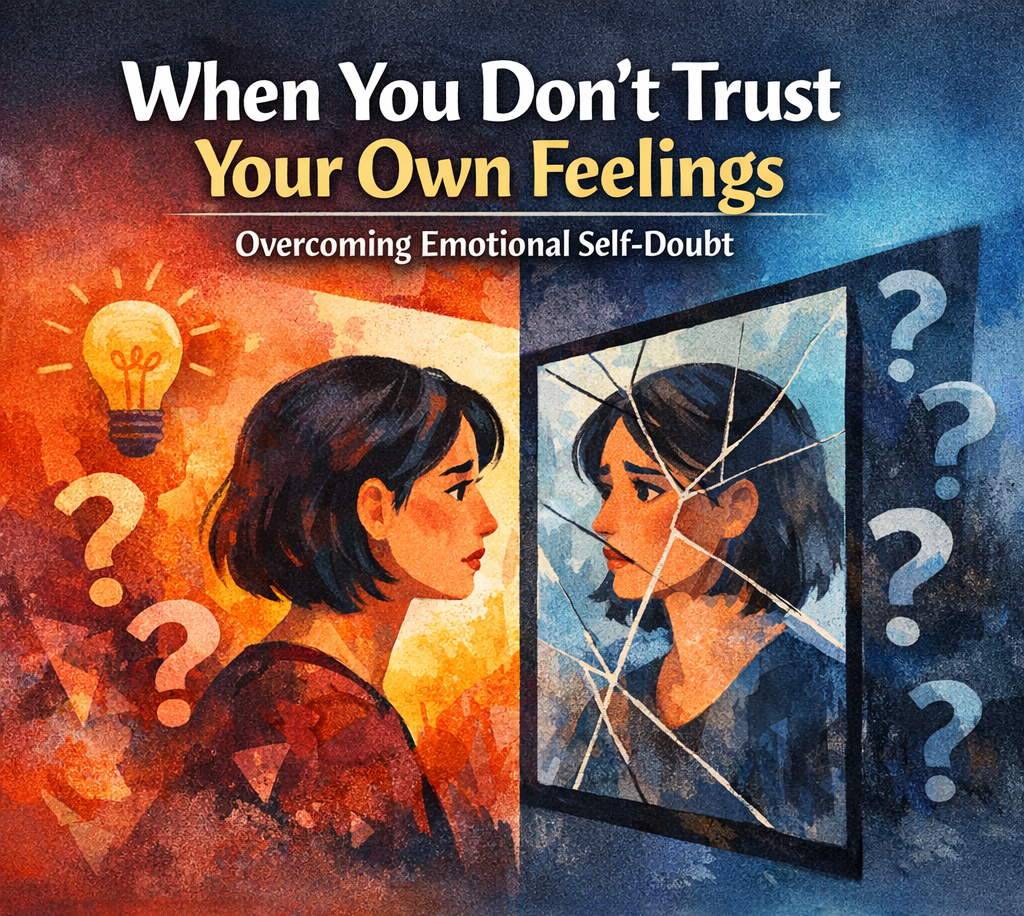
When You Don’t Trust Your Own Feelings
The Experience of Emotional Self-Doubt
Second-guessing your feelings can be exhausting. You may replay conversations in your mind, wondering whether you were too sensitive. You may leave an interaction feeling unsettled, only to convince yourself that you imagined the tension. Over time, this pattern creates chronic internal questioning.
Instead of asking, “What am I feeling?” you may ask, “Am I allowed to feel this?”
Emotional self-doubt often sounds like:
-
Maybe I’m overreacting.
-
It wasn’t that big of a deal.
-
Other people wouldn’t be upset about this.
-
I should just let it go.
While self-reflection can be healthy, persistent self-doubt erodes confidence. It creates distance between you and your internal experience. Rather than trusting your reactions as meaningful signals, you may treat them as unreliable or dramatic.
For many people, this pattern does not begin in adulthood. It develops slowly, often rooted in earlier relational environments where emotions were minimized, dismissed, or criticized.
How Emotional Mistrust Develops
When emotions are repeatedly invalidated, people adapt. If a child expresses sadness and is told they are being dramatic, or expresses anger and is labeled disrespectful, they may begin to question their own internal signals. If fear is mocked, or vulnerability is ignored, the nervous system learns that emotions are unsafe or inconvenient.
Over time, this can create a subtle but powerful shift. Instead of using feelings as internal data, a person may begin relying primarily on logic, external validation, or other people’s reactions to determine what is “appropriate” to feel.
This adaptation can appear functional on the surface. You may be thoughtful, analytical, and highly attuned to others. However, internally, there may be disconnection. Decisions feel difficult. Boundaries feel uncertain. You may ask multiple people for reassurance before trusting your own judgment.
Emotional self-doubt is frequently connected to anxiety. When you do not trust your internal cues, the mind works overtime trying to predict outcomes and avoid mistakes. This can create cycles of rumination and self-criticism. Many people explore this pattern through anxiety therapy, including evidence-based approaches such as Cognitive Behavioral Therapy described by the American Psychological Association and educational resources from the National Institute of Mental Health.
Understanding the origin of emotional mistrust is not about blaming the past. It is about recognizing that self-doubt often developed as a protective strategy.
Rebuilding Trust Through Therapy
Therapy offers something many people have never consistently experienced, a space where emotions are taken seriously.
In individual therapy, feelings are explored without judgment, dismissal, or immediate correction. Instead of being told that your reaction is wrong, you are invited to become curious about it. What does this emotion signal? What does it connect to? What does it need?
At MindSol Wellness Center, individual therapy often focuses on helping clients experience emotions as sources of information rather than problems to eliminate. Sadness may signal loss. Anger may signal a boundary. Anxiety may signal uncertainty or fear. When emotions are viewed as data rather than defects, internal trust begins to rebuild.
This process takes time. Emotional confidence does not return overnight. However, through consistent reflection and validation, many people begin noticing subtle shifts. Decisions feel less frantic. Boundaries feel more grounded. The need for constant reassurance decreases.
Gradually, the internal question changes from “Is this feeling wrong?” to “What is this feeling telling me?”
Learning to Listen to Yourself
Trusting your feelings does not mean acting impulsively or treating every emotion as a command. Emotional trust is not about intensity. It is about permission.
It means allowing emotions to exist without immediately suppressing, rationalizing, or outsourcing them. It means recognizing that your internal experience matters, even when it is inconvenient.
As emotional confidence grows, decision-making often becomes clearer and less anxiety-driven. You may notice greater steadiness in relationships. You may feel more comfortable expressing preferences. You may find it easier to identify what feels aligned and what does not.
Rebuilding trust in yourself is a gradual process of reconnection. It involves learning that your emotions are not enemies. They are signals that deserve attention.
If you struggle with emotional self-doubt, therapy can provide a structured and supportive environment to begin that work.
MindSol Wellness Center provides individual therapy in Sarasota, Florida. If you would like to speak with someone about anxiety, emotional confidence, or relationship concerns, call (941) 256-3725 or visit www.mindsolsarasota.com to learn more about scheduling a counseling session.
